Why t-shirts have much more importance in clothing in almost all the ages and genders as compared to other outfits?
by Hassan Zafar
I think the answer is simple and quite noticeable, some people wear t-shirt because of its comfort, some people wear it because of its different styles. And mostly, people who like to wear t-shirt are practical people. They don’t want to waste or spend time on choosing what outfit they should go with. Several examples are there from normal public on the streets to the billionaire of this era, the Facebook co-founder Mark Zuckerberg, he thinks that it puts too much on a hassle for choosing an outfit and that is why he wears mostly a grey t-shirt. And don’t forget the mastermind, the Apple founder, Steve Jobs!

A t-shirt is a kind of fabric shirt named after the T shape of its body and sleeves. Traditionally, it has short sleeves and a round neckline, known as a crew neck which lacks a collar. They are mainly made of a stretchy, flexible looping structure, light and inexpensive fabric and are easy to clean.
From T-shape to The T-shirt!
The earliest t-shirt dates back to sometime during Spanish-American war in late 1800s and in early 1900s, the U.S. Navy first supplied them as undergarments. It was a white cotton short-sleeved and crew necked undershirt to be worn under a uniform. Labours used to cut their jumpsuits in half to keep cool in warmer months during the year. So basically, t-shirt progressed from undergarments used in the 19th century and modified from there to general use casual clothing in the mid-20th century. Soon it became popular as a bottom layer clothing for workers in various industries. It was considered the shirt of choice for young boys because of inexpensive, easy cleaned and easily fitted characteristics. And later these t-shirts were produced in numerous colors and patterns for different target markets. The t-shirts gained more fame and achieved significance as trendy, stand-alone, outerwear garments in the 1950s after Marlon Brando, an American actor and film director, wore in one of his movie.
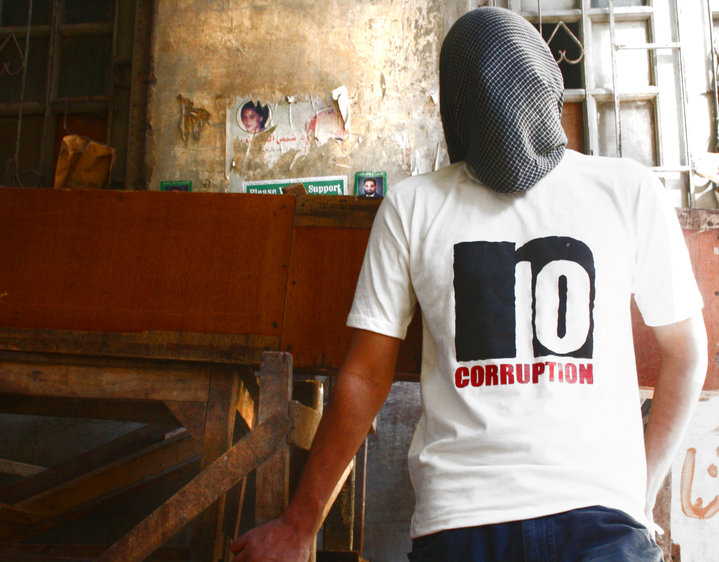
Model – Rameez Arif, Co-Founder/Artist at InkGrave Tattoo studio.
Photographer: Hassan Zafar
Prints on t-shirts were in limited use in 1940s and in the 1960s till 1990s, printed t-shirts gained acceptance and became popular for self-expression with any imaginable combination of words as well for different brand advertisements, political messages, protests and souvenirs.
In the early 2000s the rise of online shopping by online start-ups, caused a rapid increase of new t-shirt ideas and trends which led to disruptive innovations included the flip-up T-shirt, which the wearer can lift and stretch over their head to display an interior print, and all-over print clothing.
T-shirts are commonly made from cotton fibers with uniquely pliable texture in a jersey knit compared to woven fabric. These days t-shirts are produced by two main methods, the flat knit and circular knit machines. The new and modern types have a body made tubular form fabric with no side seams, produced on a circular knitting machine. The manufacturing of t-shirts has become highly mechanised including cutting the fabric with a laser or waterjet machines.
The current versions are available in many dissimilar designs, fabrics and styles include crew-neck (also called a U-neck) and V-neck shirts. In this time and era t-shirts are among the most worn garments of clothing used and are mainly popular with branding for businesses, as they are reasonable to make and purchase.
Different varieties of t-shirt fabrics
With innovations and advancements in the field of textiles, fabric plays a key role in determining a number of elements of any garment. Particularly, in the knits, fabric can determine how well a t-shirt will be able to hold its shape even after numerous numbers of washing and wearing


 TFTalk